
Free MAP Practice Test for 9th, 10th, 11th, and 12th Grade
Prepare for the MAP Test with Math, Reading, Language Usage, and Science Practice Questions
The MAP Test for 9th to 12th grade is especially important because it measures how ready your teen is for the challenges of high school.
At this stage, reading passages are more complex, math problems require advanced reasoning, and language questions demand clear writing and strong grammar.
If your child is still carrying gaps from earlier grades, the test can feel overwhelming. A strong MAP score can open doors to honors, AP, or college-prep programs and give your teen the confidence to take on more advanced coursework.
On this page, you’ll find all the resources you need to support your child’s preparation and increase their chances of scoring high:
- Free MAP practice test to help your get familiar with the question style and subjects and identify trouble areas and learning gaps.
-
Complete practice package with 47 tests and 1000+ MAP-aligned questions and explanations across Math, Reading, and Language Usage.
(This is the most comprehensive online MAP practice for these grades) - New for 2025/26! In-Depth MAP Science practice: 8 quizzes targeting all science topics that are taught in school and seen on the test (120 questions in total).
- Math Refreshers covering all the foundations: 9 quizzes to help you strengthen weak spots in math so harder questions feel easier (135 questions).

Created by Roman K., Test Prep Expert Since 2016, who has helped thousands of students achieve higher MAP scores. As a parent myself, I understand your concerns. Feel free to email me at roman@giftedready.com. I'm here to help your child succeed!
What Does the 9th-12th Grade MAP Test Include?
The high school NWEA MAP Growth test for grades 9, 10, 11, and 12 evaluates students in core academic areas, including Math, Reading, and Language Usage. Some schools also include Science.
Unlike traditional standardized exams, this test is adaptive. Questions adjust in difficulty based on how your child responds.
There’s no time limit, so students can work through each question at a pace that suits them.
Key Details for Parents:
- Subjects Covered: Math, Reading, Language Usage (ELA), and sometimes Science
- No Time Pressure: The exam is untimed
- Typical Length: About 43 questions in each subject
- Adaptive Format: Correct answers lead to more challenging questions. Incorrect answers lead to easier ones
- Wide Skill Range: Students who need more support will likely get questions at a middle school level. Advanced students may see material from grade 12 and above.
This wide range enables the test to accurately reflect your child’s learning progress, whether they are catching up, on track, or ahead of their grade level.
You’ll find sample questions below that demonstrate the different difficulty levels of each grade.
At this high school level, students will receive questions of varying difficulty levels, ranging from middle school to 12th grade.
Free MAP Practice Test - 9th, 10th, 11th, and 12th Grade (Math, Reading, Language, and Science)
Try the practice questions below to get used to the types of questions you might see on the test. These examples are taken from our complete practice package.
The following practice questions are also available in a PDF format, so you can download and print them at home.
NWEA MAP Math Practice Questions - 9th-12th Grade
The NWEA MAP Math test in high school includes 43 questions and evaluates students in the following domains:
- Operations and Algebraic Thinking
- The Real and Complex Number Systems
- Geometry
- Statistics and Probability
Let’s see several sample questions from these domains, divided into grade levels.
MAP Math 9th Grade Level Practice Question - Geometry
A swimming pool is 25 feet long, 15 feet wide, and has a depth of 5 feet. The pool is rectangular in shape.
What is the volume of the pool in cubic feet?

Show Solution
Answer: D
To calculate the volume of the swimming pool, we use the formula for the volume of a rectangular prism:
Volume = Length × Width × Depth
Given:
Length = 25 feet
Width = 15 feet
Depth = 5 feet
Now, substitute the values into the formula:
Volume = 25 × 15 × 5 = 1,875 cubic feet
The volume of the pool is 1,875 cubic feet.
MAP Math 10th Grade Level Practice Question - Statistics and Probability
The ages of 7 students in a class are: 14, 16, 15, 14, 17, 18, and 16.
Find the mean age of the students.
Show Solution
Answer: C
The ages of the 7 students are:
14, 16, 15, 14, 17, 18, 16
Add all the ages together:
14 + 16 + 15 + 14 + 17 + 18 + 16 = 110
Find the number of students:
There are 7 students.
Calculate the mean. The mean is calculated by dividing the total sum of the ages by the number of students:
Mean Age =
Sum of the ages / Number of students = 110 / 7
≈16
The mean age of the students is approximately 16 years.
MAP Math 11th Grade Level Practice Question - Operations and Algebraic Thinking
Two friends, Sarah and Jason, decided to start a small business selling custom t-shirts. Sarah and Jason each contribute money to get the business started. Sarah invests $300, and Jason invests $500.
They agree that they will share the profits equally, but Sarah will receive an additional $50 for the extra work she puts in each month managing the orders. After 4 months, the business has earned a total of $2,200 in profit.
Let’s assume that the total profit 𝑝 each month is divided between Sarah and Jason.
How much will Sarah and Jason receive for 4 months?
Show Solution
Answer: C
To determine the profit made in the first month, we need to understand how the total profit of $2,200 is distributed and then figure out how it applies to each individual month.
We know that the total profit over 4 months is $2,200, and Sarah and Jason will share this profit equally (except for Sarah’s additional $50 per month for extra work).
So, first, let’s calculate how much of the profit they would share equally without considering Sarah’s extra $50:
Sarah and Jason share equally (after Sarah’s extra work is accounted for), so the portion for Sarah and Jason before considering the $50 extra per month can be calculated by subtracting the $50 per month (4 months x $50) for Sarah from the total:
Total profit after Sarah’s extra work = 2,200 – (4 × 50)
Total profit after Sarah’s extra work = 2,200 −200 = 2,000
This means that $2,000 is split equally between Sarah and Jason.
Each person’s share of the $2,000:
2000 / 2
= 1000
So, for 4 months, Sarah and Jason would each receive $1,000 in profit, before considering Sarah’s $50 extra for each month.
Since Sarah gets an additional $50 each month for her extra work, we can now see how the $200 (4 months × $50) is distributed.
Sarah’s total amount after 4 months:
1,000 + 200 = $1,200
Jason’s total amount after 4 months remains $1,000.
Sarah will receive $1,200 over the 4 months (her $1,000 share of the profit + $200 for extra work).
Jason will receive $1,000 over the 4 months (his share of the equal profit).
MAP Math 12th Grade Level Practice Question - Statistics and Probability
How many different ways can 4 friends sit in a row at a theater?

Show Solution
Answer: E
To find how many different ways 4 friends can sit in a row at a theater, we need to calculate the permutations of 4 objects.
The formula for the number of permutations of 𝑛 distinct objects is:
P(n)=n!
Where 𝑛! (read as “n factorial”) means the product of all positive integers from 1 to 𝑛.
Given: 𝑛 = 4 (since there are 4 friends)
Apply the formula:
P(n)=n!
P(4)=4!
P(4)=4×3×2×1
P(4)=24
There are 24 different ways that 4 friends can sit in a row at a theater.
The Most Comprehensive Practice to Boost Your Child's MAP Scores
Help your child prepare with a complete practice package designed to improve their skills and maximize their performance on the test.
Build Confidence with 6 Full-length Simulations
Master All Test Areas with 41 Quizzes in Varying Levels
Get Exclusive Practice for the MAP Science Test
Close Learning Gaps with Math Refresher Quizzes
NWEA MAP Reading Practice Questions - 9th-12th Grade
The NWEA MAP Reading test consists of 43 questions that are divided into the following three domains:
- Literary Text
- Informational Text
- Vocabulary
Here are a few examples from these domains, divided into 9th to 12th-grade-level questions.
MAP Reading 9th Grade Level Practice Question - Informational Text
Text 1: Arctic Fox
The Arctic fox is a small, white mammal that lives in the freezing Arctic regions. Its thick fur keeps it warm, and it even grows more fur on its feet to help it walk on snow. In the winter, the Arctic fox’s fur turns pure white to blend in with the snow and stay hidden from predators. In the summer, it changes to a brown or grey color to match the rocks and soil. This change in color helps the fox survive in different seasons.
Text 2: Fennec Fox
The Fennec fox lives in the hot, sandy deserts of North Africa. It has large ears that help it hear insects underground—and also help cool its body by releasing heat. Its pale fur reflects sunlight and keeps it from getting too hot. Unlike the Arctic fox, the Fennec fox is active mostly at night when the desert is cooler. This helps it avoid the daytime heat.
How are the Arctic fox and the Fennec fox similar?
Show Solution
Correct Answer: D. They are both adapted to survive in extreme climates.
The Arctic fox is adapted for freezing temperatures, while the Fennec fox is built for desert heat. Both animals have special features that help them survive in their environments.
MAP Reading 10th-11th Grade Level Practice Question - Literary Text
Read the story.
The Midnight Garden
Every night, Liam looked out his window at the overgrown garden behind his apartment. Once, long ago, it had been beautiful, with neat flower beds and a winding stone path. But after years without care, weeds had swallowed the roses, and vines crept over the benches. Most people thought it was just an eyesore, a forgotten patch of land no one wanted.
Liam often felt lonely since moving to the city. He missed the small town where he’d grown up, where everyone knew each other, and the nights were quiet. One evening, when he couldn’t sleep, he sat by the window and watched the garden. At first, he saw nothing but tangled leaves. But then, tiny lights began flickering among the weeds, like sparks drifting through the dark.
Curious, he slipped outside and walked carefully along the old path. As he reached the centre of the garden, dozens of fireflies lifted into the air around him. Their soft glow seemed to fill the night with calm. For the first time in weeks, Liam felt peaceful.
From that night on, whenever he felt overwhelmed or alone, Liam visited the midnight garden. The fireflies always returned, lighting the tangled branches with their quiet beauty. Standing there, Liam realized that even neglected places—and lonely people—could hold something unexpectedly bright.
Which statement best expresses the theme of this story?
Show Solution
Correct Answer: C.
The theme shows that beauty and hope exist even in neglected places, as demonstrated by the fireflies bringing comfort to Liam in his loneliness.
Why the other choices are incorrect:
A: The story uses fireflies symbolically, not just as an interesting insect.
B: There is no mention of danger in the garden; the experience is comforting.
D: Gardening skills are never discussed—the focus is on discovery and emotional healing.
MAP Reading 12th Grade Level Practice Question - Vocabulary
What does the prefix hypo- mean in the word hypothermia?
Show Solution
Correct Answer: E. Under
E (Under) is correct because hypo- means under, below, or less than normal, which matches hypothermia (body temperature below normal).
Why the other choices are incorrect:
A) Hyper- means over.
B) Post- means after.
C) Pre- means before.
D) Homo- or iso- means same.
NWEA MAP Language Usage Practice Questions - 9th-12th Grade
The NWEA MAP Language Usage test includes 43 questions and consists of three domains:
- Language: Understand, Edit for Grammar, Usage
- Language: Understand, Edit for Mechanics
- Writing: Write, Revise Texts for Purpose and Audience
Let’s see a few sample questions from these domains.
MAP Language Usage 9th Grade Level Practice Question - Grammar
Identify if the following sentence has a misplaced modifier, dangling modifier, or no error:
“The student nearly completed all of the assignments in two hours.”
Show Solution
The correct answer is: A. Misplaced modifier.
The modifier “nearly” is misplaced.
The sentence suggests the student nearly completed the work (implying they did not), but it likely intends to say they completed nearly all of the assignments.
It should be written as: “The student completed nearly all of the assignments in two hours.”
A dangling modifier (option B), on the other hand, means there’s no subject for the modifier to describe, but the subject (“The student”) is present.
MAP Language Usage 10th-11th Grade Level Practice Question - Mechanics
Which sentence correctly uses punctuation to separate clauses?
Show Solution
Correct Answer: B
Each part – “She loves mystery novels,” “he prefers science fiction,” and “they both enjoy reading together” – is an independent clause (a complete sentence).
You can connect independent clauses in two good ways:
- Semicolon with no conjunction:
She loves mystery novels; he prefers science fiction. - Comma + coordinating conjunction:
… he prefers science fiction, but they both enjoy reading together.
Sentence B uses both rules properly: first a semicolon (no conjunction), then a comma + but.
Why the others are wrong:
- A & E: Use a semicolon before “but.” If you use but, use a comma, not a semicolon.
- C: Comma splices (commas join full sentences without a conjunction).
- D: A colon is for introducing an explanation/list; it doesn’t fit normal clause joining here.
MAP Language Usage 12th Grade Level Practice Question - Writing
Which of the following is the best topic sentence for a paragraph about how social media affects communication?
Show Solution
Correct answer – C.
This sentence introduces the main idea of how social media has altered communication. It highlights a contrast that can be explored in the paragraph – speed versus personal connection.
Why the other choices are incorrect:
A. This is a personal example, not a general statement that guides the paragraph.
B. This introduces a fact about popularity, not communication.
D. This focuses on different platform preferences, which is too narrow and off-topic regarding the impact on communication.
Mind the Gaps Before They Grow
Many high schoolers carry learning gaps from middle school, or even earlier.
By the time they reach high school, reading passages are longer, denser, and more abstract, and language usage questions demand sharper grammar and writing skills.
If these gaps aren’t addressed, students may find themselves struggling to keep up.
Using targeted practice tests and focused study is one of the most effective ways to close these gaps and build the skills needed for advanced coursework.
NWEA MAP Science Practice Questions - 9th-12th Grade
The NWEA MAP Science test in 9th to 12th grades is an optional section that some schools use to measure a student’s understanding of the following key scientific concepts:
- Life Science
- Physical Science
- Earth and Space Science
- Students also need to demonstrate their understanding of science and engineering practices, as well as crosscutting concepts, which are included in some test questions.
MAP Science 9th-12th Grade Practice Question - Life Science
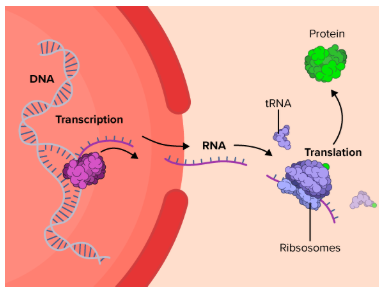
The diagram illustrates the process of protein synthesis. A change in the DNA sequence, known as a mutation, occurs in a gene.
What is the most likely immediate effect of this mutation on the cell’s processes?
Show Solution
Correct Answer: B
The sequence of nucleotide bases in a gene (a segment of DNA) provides the code for the sequence of amino acids in a protein. This code is first transcribed into a messenger RNA (mRNA) molecule.
The ribosome then translates the mRNA code to assemble the protein. Suppose a mutation alters the original DNA sequence.
In that case, the mRNA transcript will also be altered, which can lead to the incorporation of a different amino acid or a premature stop codon during translation, potentially changing the structure and function of the final protein.
MAP Science 9th-12th Grade Practice Question - Earth and Space Science
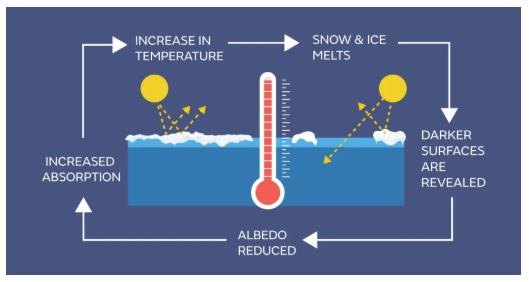
The cycle shown in the diagram, where melting sea ice leads to more absorbed sunlight and thus more melting, is an example of a positive feedback loop. This type of loop _______________ the initial change in the system.
Show Solution
Correct Answer: amplifies
Feedback loops are processes within a system where the output of an action influences that same action. A positive feedback loop amplifies or reinforces the initial change.
In this case, the initial warming is amplified because the result of the warming (less ice) causes a change (lower albedo) that leads to even more warming.
In contrast, a negative feedback loop would counteract the initial change, stabilizing the system. The ice-albedo feedback is a critical and concerning positive feedback loop in Earth’s climate system.
MAP Science 9th-12th Grade Practice Question - Physical Science
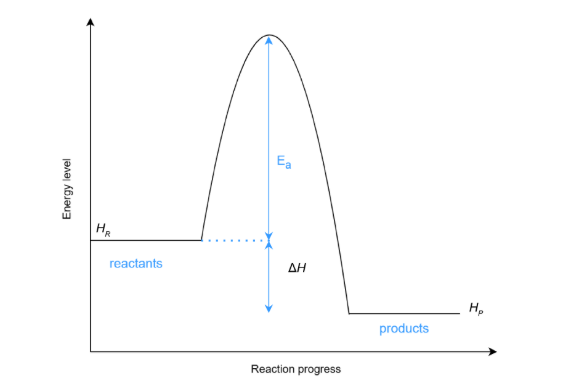
The diagram shows the energy change during a chemical reaction.
Because the products are at a lower potential energy state than the reactants, the reaction is exothermic.
What does this imply about the bond energies?
Show Solution
Correct Answer: D
A chemical reaction involves two main energy processes: energy is absorbed to break the chemical bonds of the reactants, and energy is released when new chemical bonds are formed in the products.
In an exothermic reaction, there is a net release of energy into the surroundings.
This occurs because the bonds formed in the product molecules are stronger (more stable, lower potential energy) than the bonds that were broken in the reactant molecules.
Therefore, the energy released upon product formation exceeds the energy absorbed to break the reactant bonds.
Give Your Child the Tools to Excel & Score High
Get the complete practice package and access 1000+ Practice Questions & Explanations in Math, Reading, Language Usage, and Science.
MAP Scores for 9th–12th Grade: What They Mean & How to Use Them (Including Charts)
MAP scores in high school provide important insights into your teen’s readiness for advanced coursework and future academic paths.
After testing, your child will receive a RIT score in Reading, Math, Language Usage, and Science.
The RIT score is a scaled number that shows both the student’s instructional level and their growth over time. For example, if a student scored 235 in 9th grade and later earned 245 in 10th grade, that reflects meaningful academic progress.
Along with the RIT, you’ll also see a percentile ranking. This tells you how your child compares to students nationwide in the same grade.
For instance, a student in the 80th percentile performed better than 80% of peers across the country.
For high schoolers, these results can highlight whether a student is on track for success in college-prep classes, AP/IB programs, or dual-enrollment opportunities. They also give teachers and parents clear guidance on which areas need reinforcement before graduation.
Average RIT Score Ranges for Students in Grades 9 to 12
| 9th Grade | ||||
|---|---|---|---|---|
| Mathematics | Language Usage | Reading | Percentile | |
| Higher Achievement | 259 | 242 | 250 | 95 |
| 246 | 232 | 238 | 84 | |
| 236 | 224 | 228 | 69 | |
| Median and Mean | 226 | 219 | 217 | 50 |
| Lower Achievement | 217 | 209 | 209 | 31 |
| 207 | 201 | 200 | 16 | |
| 194 | 191 | 188 | 5 | |
| 10th Grade | ||||
|---|---|---|---|---|
| Mathematics | Language Usage | Reading | Percentile | |
| Higher Achievement | 262 | 244 | 251 | 95 |
| 249 | 234 | 239 | 84 | |
| 239 | 226 | 230 | 69 | |
| Median and Mean | 229 | 219 | 221 | 50 |
| Lower Achievement | 219 | 211 | 213 | 31 |
| 209 | 204 | 204 | 16 | |
| 196 | 194 | 192 | 5 | |
| 11th Grade | ||||
|---|---|---|---|---|
| Mathematics | Language Usage | Reading | Percentile | |
| Higher Achievement | 266 | 245 | 253 | 95 |
| 252 | 236 | 241 | 84 | |
| 242 | 228 | 232 | 69 | |
| Median and Mean | 232 | 221 | 224 | 50 |
| Lower Achievement | 222 | 213 | 215 | 31 |
| 211 | 206 | 206 | 16 | |
| 198 | 196 | 194 | 5 | |
| 12th Grade | ||||
|---|---|---|---|---|
| Mathematics | Language Usage | Reading | Percentile | |
| Higher Achievement | 269 | – | 256 | 95 |
| 254 | – | 243 | 84 | |
| 244 | – | 233 | 69 | |
| Median and Mean | 223 | – | 224 | 50 |
| Lower Achievement | 222 | – | 214 | 31 |
| 212 | – | 205 | 16 | |
| 197 | – | 191 | 5 | |