OLSAT Figural Reasoning Practice Questions, Tips & Prep Strategies

GiftedReady - Ace the Test, Unlock the Future

OLSAT Figural Reasoning challenges many students with its visual puzzles. These questions test a student’s ability to recognize patterns, understand shapes, and solve problems without words.

Many students find this section difficult because it is different from typical math or reading questions.

This guide explains each type of Figural Reasoning question in simple terms. It also provides practical tips, sample questions, and step-by-step strategies.

It will help your child build confidence, improve their problem-solving skills, and increase their overall OLSAT scores.

Let’s get started!

Author picture

Created by Roman K., Test Prep Expert Since 2016, who has helped thousands of students achieve higher scores. As a parent myself, I understand your concerns. Feel free to email me at roman@giftedready.com. I'm here to help your child succeed!

Table of Contents

What Is the Figural Reasoning Section of the OLSAT?

The Figural Reasoning section is part of the OLSAT Nonverbal section. It focuses on solving problems using shapes, patterns, and visual designs.

They are not like verbal questions that use words. Figural Reasoning uses images to test thinking skills.

Your child sees a series of shapes or patterns and must find the missing piece or identify the rule. This section measures nonverbal reasoning. It tests how well students recognize relationships between figures.

It also checks their ability to predict what comes next in a sequence. Figural Reasoning is a key part of the OLSAT because it shows how students solve problems without language.

Why Figural Reasoning Matters in Gifted Testing

Figural Reasoning is important in gifted testing because it measures skills beyond reading and math. It reveals a student’s ability to think visually and logically.

Many gifted children excel in nonverbal reasoning, which can show potential even if verbal skills are still developing.

This section helps schools identify students with strong visual and spatial intelligence. These skills are important in fields like science, technology, engineering, and art.

Figural Reasoning also shows creative problem-solving ability. Because it does not rely on language, it can fairly assess students from different backgrounds.

Figural Reasoning helps find students who think differently and solve problems in unique ways. This makes it a vital part of the OLSAT and gifted programs.

Types of Figural Reasoning Questions on the OLSAT

The Figural Reasoning section of the OLSAT includes four main types of questions. Each type tests different visual thinking skills.

Figural Classification (Levels A-D)

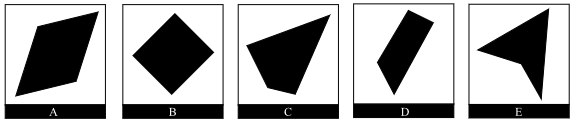
Figural Classification questions ask students to find the figure that does not belong in a group. Look at several shapes and find the different one. This tests the ability to recognize similarities and differences.
Sample Question

OLSAT Figure Classification Sample Question

The correct answer is B.

In this pattern, all of the following are quadrilaterals with at least one acute angle, except for option B, which consists of four right angles.

Figural Analogies (Levels A-G)

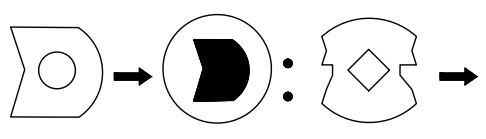
Figural Analogies show two related shapes or patterns. You must find a figure that has the same relationship to a third shape. This type tests understanding of relationships and how one figure changes to become another.
Sample Question

OLSAT Practice Question - Figural

Answer Choices for Figural Reasoning Question

The correct answer is A.

The inner shape on the left becomes the outer shape on the right, while the outer shape on the left becomes the inner shape on the right and is shaded black.

Pattern Matrix (Levels A-G)

Pattern Matrix questions present a grid of shapes with one missing piece. You need to study the rows and columns to find the pattern. Then, choose the figure that completes the grid. This tests pattern recognition and logical thinking.

Sample Question

PAttern Matrix Sample Question - OLSAT Test

The correct answer is D.

In the top row, every arrow in the left frame goes with a particular figure in the right frame.

  • Arrow pointing right = diamond
  • Arrow pointing left = hexagon
  • Arrow pointing down = pentagon
  • Arrow pointing up = triangle

Only shapes at option D have a similar relationship, so D is the correct answer.

Figural Series (Levels A-G)

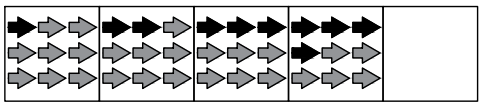
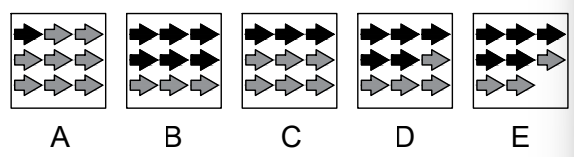
Figural Series questions show a sequence of shapes or designs. You must identify the rule that links the figures. Then, select the next figure in the series. This type measures the ability to see order and predict what comes next.
Sample Question

Figural Series Sample Question - OLSAT

Answer Choices for Figural Series Question

The correct answer is D.

The number of black shaded arrows increases by one while the number of grey shaded arrows decreases by one in each cell.

The total number of arrows in each cell is equal to nine.

Breakdown of Common Patterns and Rules in Figural Reasoning

Many OLSAT Figural Reasoning questions are built on recurring visual rules. Recognizing these patterns quickly can save time and improve accuracy. Questions may combine more than one rule, but the list below covers the most common ones:

  • Rotation – The figure turns clockwise or counterclockwise by a set angle (e.g., 90°, 180°).
  • Reflection – The figure flips horizontally, vertically, or diagonally like a mirror image.
  • Size Change – The figure increases or decreases in size at each step.
  • Shading or Color Change – The shading pattern changes from light to dark, filled to empty, or alternates between colors.
  • Number of Elements – Shapes are added or removed in a predictable sequence.
  • Position Shift – The figure moves across the frame in a specific direction and distance.
  • Shape Change – One shape changes into another (e.g., square to triangle) while keeping other features the same.
  • Pattern Combination – Two or more rules happen together, such as a shape rotating while changing size.

Tip: When solving, first scan for the simplest rule. If you can’t spot it immediately, check one feature at a time (rotation, shading, number of parts) to avoid feeling overwhelmed.

OLSAT Figural Reasoning Test Format and Scoring

Figural Reasoning questions are mixed with other nonverbal items rather than appearing in one block. This means students need to be ready to switch between different question types during the test.

Scoring for Figural Reasoning is combined with the rest of the OLSAT results to create the overall score. The raw score is converted into a School Ability Index (SAI) and percentile rank. These scores help schools understand a student’s reasoning ability compared to others in the same age group. 

See our OLSAT Scores page for detailed scoring information.

Preparing for the Figural Reasoning Section

Students can improve in Figural Reasoning by becoming familiar with the types of patterns, shapes, and spatial relationships that appear on the test. Encourage your child to practice identifying similarities, differences, rotations, and progressions in images.

Work on one type of question at a time before mixing them together. Keep practice sessions short and consistent to build accuracy without causing fatigue.

Recommended Practice Questions and Materials

Practice tests that match the OLSAT format are one of the most effective tools. They help students get used to switching between different nonverbal question types, since figural items are not grouped together on the actual test.

Time Management Strategies for Test Day

Students should pace themselves and avoid spending too long on a single question. If an item seems too complex, skip it and return later if time allows. Practice with timed sets at home to develop a steady rhythm and reduce stress on test day.

Remind your child that all questions have equal weight, so no single problem is worth sacrificing time for multiple others.

Common mistakes to avoid

Many students overthink patterns or focus on unnecessary details. Encourage your child to look for the simplest and most consistent rule in the sequence or set. Another common mistake is rushing through easy-looking items, which can lead to careless errors.

Regular practice helps build the balance between speed and accuracy needed for this section.

Frequently Asked Questions (FAQs)

What Is the Hardest Type of Figural Reasoning Question?

Difficulty varies by student, but many find Pattern Matrix questions most challenging. These require recognizing multiple changes at once, such as shape, size, shading, and position. Practicing each type separately before mixing them can make these questions easier.

How Early Should Children Start Preparing?

Preparation can begin a few months before the test. Short, regular sessions are more effective than cramming. Early exposure to puzzles, pattern games, and visual problem-solving activities can help build the skills tested in Figural Reasoning.

How To Handle Test Anxiety Related to Figural Reasoning?

Anxiety often comes from uncertainty. Practicing with sample questions and timed sets can make the test feel more familiar. Encourage your child to take deep breaths and focus on one question at a time. Remind them that it’s okay to skip a tricky item and return to it later.

Conclusion

The Figural Reasoning section of the OLSAT challenges students to think visually, recognize patterns, and solve problems without the help of words. It measures skills that are important for success in many areas, from science and technology to art and design.

The variety of shapes, sequences, and transformations can be tricky at first. But after understanding the common rules, such as rotation, reflection, size change, shading, and number of elements, it can become easier.

Practicing each question type, reviewing recurring patterns, and working with timed sets helps students build both speed and accuracy. Consistent exposure to visual puzzles, games, and practice tests reduces uncertainty and boosts confidence.

Parents can support their child by making practice sessions short, regular, and engaging, so the skills develop naturally over time.