Renaissance STAR 1st and 2nd Grade Practice Test in Reading & Math
Build Your Child’s Skills and Confidence Before the Actual Test with Lifelike STAR Practice Questions
Welcome to your ultimate practice resource for the Renaissance STAR Test for 1st and 2nd Grade!
This page includes all the up-to-date information and practice materials to support your child’s preparation and maximize their score potential.
Here’s what you’ll find:
- Free STAR 1st & 2nd Grade Practice Test and PDF (Math and Reading): Get a quick sample test to help your child become familiar with STAR-style questions and show you where they might need extra help.
-
Complete Practice Package with 7 Full-length Simulations and 16 Practice Tests: Your child gets extensive practice across a wide variety of skills evaluated on the STAR test. Every question includes child-friendly explanations.
(This is the most comprehensive STAR practice found online.)
Let’s help your child get ready and score high on the test!
Created by Roman K., Test Prep Expert Since 2016, who has helped thousands of students achieve higher scores. As a parent myself, I understand your concerns. Feel free to email me at roman@giftedready.com. I'm here to help your child succeed!
What to Expect on the STAR 1st and 2nd Grade Test?
The STAR assessment for 1st and 2nd grade is a computer-adaptive test developed by Renaissance and used by schools to measure reading and math skills. The test adjusts the difficulty of each question based on the child’s previous answers, so every student receives a personalized set of questions.
The test usually takes about 15–20 minutes per subject. It’s taken on a computer or tablet, and focuses on foundational skills aligned with classroom instruction.
The scores are used by teachers to monitor progress, identify skill gaps, and support low- and high-achieving students.
Key Takeaways
- Who takes it: Grade 1-2 students.
- Structure: Includes two sections (subjects) that are scored separately – Reading and Math.
- Format: Computer-adaptive. Multiple-choice/picture-based items adjust to your child’s performance.
- Number of questions per subject: 34 items (the system may add a few if needed).
- Time limits: Untimed overall, but each test question has a time limit of 4 to 8 minutes.
Try the practice questions below with your child to give them a feel for the question types and topics they will be tested on.
These questions are also available in PDF format, so you can download and print them.
STAR 1st and 2nd Grade Practice Test – Reading
In first and second grade, the STAR Reading Test evaluates your child on four specific domains:
- Word Knowledge and Skills
- Comprehension Strategies and Constructing Meaning
- Analyzing Literary Text
- Understanding Author’s Craft
Each of these domains is further divided into 30+ skill areas and more than 100 subskills.
Let’s try practice questions from each domain, taken from the complete practice package.
Note that the complete package covers most of these 100+ subskills, so your child gets a chance to practice and improve the most important reading skills.
STAR Reading Grade 1 and 2 Sample Question – Word Knowledge and Skills
The poster said the cat was timid. It said the cat might hide in small, quiet places and may not come when called.
What does timid mean?
Show Explanation
Correct Answer: Scared or shy
To figure out what timid means, we look at the clues in the sentence.
Context clues are hints in the sentence that help us figure out the meaning of a word we do not know.
We look at what the sentence says about the cat:
- The cat might hide.
- It hides in small, quiet places.
- It may not come when called.
These clues tell us that the cat does not feel brave.
A cat that hides and does not want to come out is scared or shy.
So, the word timid means scared or shy.
STAR Reading Grade 1 and 2 Sample Question – Comprehension Strategies and Constructing Meaning
What is the main purpose of this poster?

Show Explanation
Correct Answer: To invite people to join a recycling event
When we talk about the purpose of a text, we mean why the author wrote it.
The purpose tells us what the text wants us to do, learn, or feel.
Here are some common purposes:
- To inform – to give information or facts.
- To entertain – to tell a story or make you enjoy reading.
- To persuade – to make you do something or agree with an idea.
Now, look at the poster:

This poster is asking people to join an event that helps the environment.
It gives details like when, where, and what to bring, which means it’s trying to invite people to join a recycling event.
STAR Reading Grade 1 and 2 Sample Question – Analyzing Literary Text
Read the story.

Which event happened first in the story?
Show Explanation
Correct Answer: Liam and Zoe ride their bikes to the library.
To figure out which event happened first, we look at the order of the story:

- The story begins with: “One Friday afternoon, Liam and his sister Zoe rode their bikes to the town library.” This is the very first thing that happens.
- Later, Liam notices his backpack is missing.
- Finally, they find their favorite books and sit down to read.
STAR Reading Grade 1 and 2 Sample Question – Understanding Author’s Craft
Read the passage.
“Sofia walked into the school gym for the morning assembly. She heard the principal clapping his hands to get everyone’s attention. The students whispered quietly to each other, and the floor creaked under their shoes. Outside, the birds chirped loudly near the windows. Sofia covered her ears for a moment, but then listened carefully to the announcements.”
Select the sentence that does not describe a sound.
Show Explanation
Correct Answer: Sofia walked into the school gym for the morning assembly.
When a question asks about sound, look for words that show what you can hear. Sentences that describe actions, feelings, or sights are not sounds.
The question asks you to find the sentence that does NOT describe a sound.
Sentence 1: Outside, the birds chirped loudly near the windows.
This describes a sound (chirping birds).
Sentence 2: Sofia walked into the school gym for the morning assembly.
This tells an action, not a sound.
Sentence 3: She heard the principal clapping his hands to get everyone’s attention.
This describes a sound (clapping).
Give Your Child the Tools to Score High on the STAR Test
Support your child with a research-backed practice created to reduce stress, sharpen their math and reading skills, and boost confidence ahead of the test.
The Most Comprehensive Practice Available
Fun & Engaging Learning Designed for Kids
Created by Teachers & Test Prep Experts
STAR 1st and 2nd Grade Practice Test – Math
The STAR Math test for 1st and 2nd grade also assesses your child on four domains:
- Numbers and Operations
- Algebra
- Geometry and Measurement
- Data Analysis, Statistics, and Probability
Compared to the Reading part, it covers even more skill areas and subskills, with over 220 such subskills.
As noted earlier, the complete practice package includes questions from most of these subskills, so your child can build and improve those key abilities.
Let’s solve practice questions from these four domains, so that your child gets a feel for the actual question types.
STAR Math Grade 1 and 2 Sample Question – Numbers and Operations
A baker made a magical rainbow pizza and sliced it into 6 equal pieces.
Her friend ate 1 slice of the pizza.
Which fraction model represents one slice of the pizza that has been eaten?
Show Explanation
Correct Answer: A
The baker cut the rainbow pizza into 6 equal pieces.
That means the whole pizza is divided into 6 parts.
Each part is 1 out of 6 equal parts of the pizza.

If her friend ate 1 slice, she ate 1 out of 6 of the whole pizza.
So, the fraction model that shows 1 slice out of 6 equal parts is the one with one part shaded and five parts not shaded.

STAR Math Grade 1 and 2 Sample Question – Algebra
Look at the pattern below:

What shape should come next?
Show Explanation
Correct Answer: C
Let’s look closely at the pattern:
We can see that it repeats every four shapes:
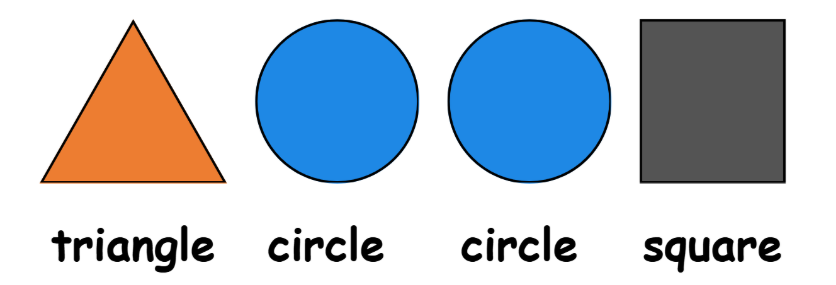
So after the last triangle, the next shape should be a blue circle to start the next group.

STAR Math Grade 1 and 2 Sample Question – Geometry and Measurement
Which customary unit would you use to measure the length of a school hallway?

Show Explanation
Correct Answer: D
A school hallway is very long, much longer than a pencil or a desk.
Inches are for small things like crayons.

Feet are for medium things like doors or people.

Miles are for very long distances, like roads.

A hallway is long, but not as long as a road.
So we use yards to measure a school hallway.
STAR Math Grade 1 and 2 Sample Question – Data Analysis, Statistics, and Probability
Last weekend, a pet grooming shop called Pawfect Care counted how many pets they washed.
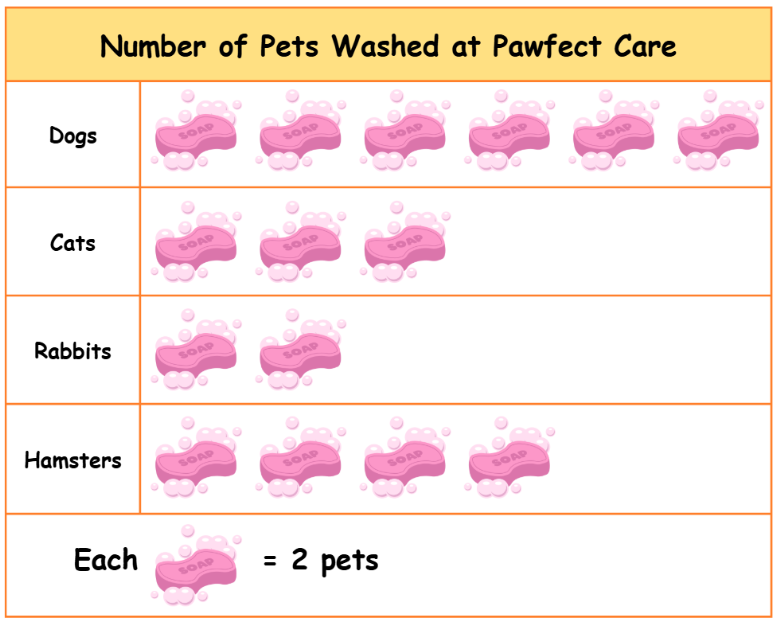
How many more dogs than cats were washed?
Show Explanation
Correct Answer: D

It means every picture represents 2 pets washed.
Let’s compare the number of dogs and cats washed.

- Dogs → 6 pictures × 2 = 12 dogs washed
- Cats → 3 pictures × 2 = 6 cats washed
Now, find how many more dogs than cats were washed:
12 − 6 = 6 more dogs than cats
6 more dogs than cats were washed.
Keep Practicing to Help Your Child Sharpen Skills & Score High
Get the most comprehensive STAR 1st-2nd Grade practice package with 7 full-length practice simulations and 16 practice quizzes covering all domains and skill areas.
Each question includes a clear and child-friendly explanation, similar to the sample questions above.